Course Purpose
This course empowers diploma-level educators and trainers to master the design, delivery, and continuous improvement of competency-based assessments, fostering equitable, authentic evaluation systems that develop 21st-century skills and align with Kenya's TVET reforms for workforce readiness.
Course Learning Outcomes
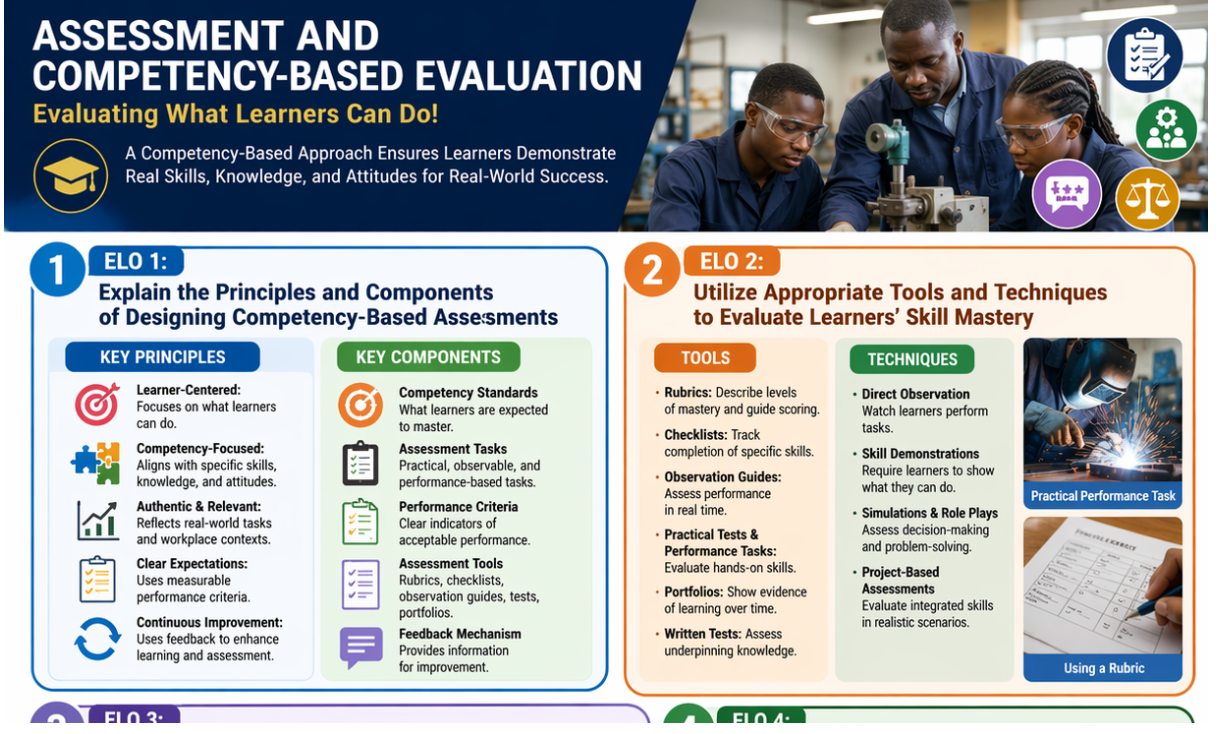
CLO 1: Explain the principles and components of designing competency-based assessments.
CLO 2: Utilize appropriate tools and techniques to evaluate learners’ skill mastery.
CLO 3: Apply effective feedback strategies to support learner improvement in CBET.
CLO 4: Uphold ethical practices and fairness in conducting competency-based evaluations
Course Content
- Foundations of Competency-Based Assessment: Describe the core principles of CBET and their distinctions from traditional assessment models ,Classify assessment tools by their alignment to CBET mastery criteria ,Apply CBET frameworks to deconstruct a diploma-level competency statement.
- Revised Bloom's Taxonomy in Assessment Design: Identify the hierarchical levels and verb examples in revised Bloom's Taxonomy ,Compose domain-specific learning outcomes using precise active verbs; Implement Bloom-aligned outcomes in a sample diploma lesson plan, Analyse the strengths and gaps in one's outcome-writing process.
- Designing Authentic Assessments; Describe characteristics of authentic vs. traditional assessments ,Develop rubrics for authentic tasks aligned to 21st-century skills ,Construct and prototype an authentic task for a trade module ;Evaluate rubric effectiveness through self-testing.
- Formative Strategies for Competency Progression; DESCRIBE formative tools supporting CBET progression ,Construct customizable feedback protocols for group learning ,Implement formative strategies in a virtual classroom simulation, Monitor and adjust feedback based on observed learner trajectories.
- Summative Assessment and Competency Mastery; Explain mastery benchmarks in CBET summative, Assemble comprehensive summative instruments. Administer and score a mastery demonstration, Judge instrument equity through bias audits.
- Digital Integration in Competency Evaluation; Recognize features of digital assessment platforms, Integrate platforms into CBET workflows, Analyse a digital pilot assessment, Reflect on digital tool equity for diverse users.
- Ensuring Inclusive Competency Evaluation); Define inclusivity standards in CBET ; Adapt assessments for learner diversity, Retrofit a standard tool for inclusivity; Evaluate personal equity practices.
- Data-Driven Evaluation and Analytics)- Identify competency analytics metrics, Interpret multivariate data trends , Generate data-driven recommendations ;Synthesize analytics for reform advocacy.
- Collaborative Frameworks in Assessment; Outline collaborative CBET models, Facilitate reliability calibration sessions, Co-evaluate a shared portfolio, Analyse collaboration dynamics.
- Leading CBET Evaluation Reforms Describe leadership competencies in CBET reform ; Develop an institutional assessment framework, Pitch framework to simulated stakeholders, Evaluate personal leadership growth over the course .