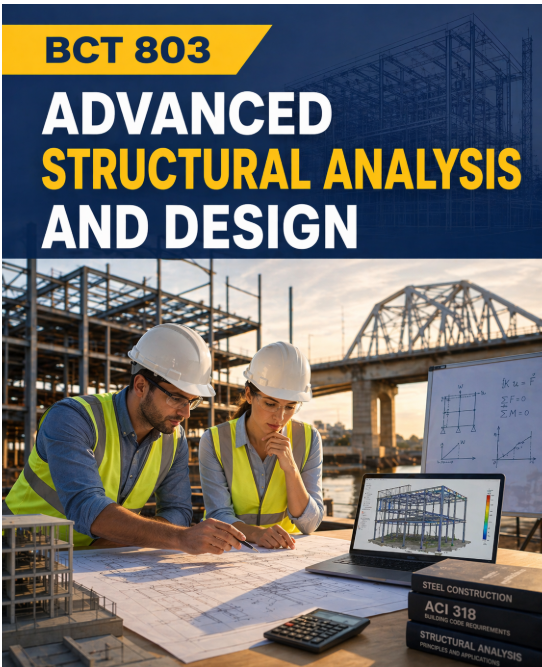
Course Purpose
To equip the learner with knowledge, skills and attitudes on Advanced Structural Analysis and Design.
Course Learning Outcomes
CLO 1: Explain the principles and theories underlying advanced structural analysis methods, including finite element analysis and dynamic load assessment.
CLO 2: Apply advanced analytical techniques and computational tools to solve complex structural engineering problems.
CLO 3: Analyze structural systems and components to identify failure modes and optimize design for performance and safety.
CLO 4: Evaluate and compare different structural design solutions considering factors such as efficiency, cost-effectiveness, sustainability, and compliance with design codes.
Course Content
Matrix Methods of Structural Analysis:Introduction to Matrix Algebra, Stiffness and Flexibility Methods, Direct Stiffness Method for Trusses, Beams, and Frames, Solution of Large Structural Systems, Computer Implementation and Software Applications. Finite Element Analysis (FEA): Fundamentals of Finite Element Method, Element Types and Shape Functions, Formulation of Stiffness Matrix and Load Vector, Assembly and Solution Techniques, Application to Structural Elements: Beams, Plates, and Shells. Nonlinear Structural Analysis: Introduction to Nonlinear Behavior in Structures, Material Nonlinearities: Plasticity, Creep, and Cracking, Geometric Nonlinearities; Large Deformations and Stability, Solution Techniques for Nonlinear Equations. Dynamic Analysis of Structures: Fundamentals of Structural Dynamics, Free and Forced Vibrations of Single and Multi-Degree-of-Freedom Systems, Modal Analysis and Time History Analysis, Response Spectrum Analysis, Earthquake Engineering and Seismic Design. Stability of Structures: Concepts of Structural Stability, Buckling of Columns, Beams, and Frames, Lateral-Torsional Buckling, Stability of Plates and Shells, Post-Buckling Behavior and Imperfection Sensitivity Advanced Reinforced Concrete Design: Behavior of Reinforced Concrete Members, Advanced Topics in Flexural and Shear Design, Design of Slender Columns and Walls, Seismic Design of Reinforced Concrete Structures, Performance-Based Design and Assessment Advanced Steel Structure Design: Design of Steel Members under Complex Loading Stability and Design of Steel Frames, Connections; Bolted and Welded, Design of Composite Steel-Concrete Structures, Fire Resistance and Design for Durability Structural Optimization: Principles of Optimization in Structural Engineering, Formulation of Optimization Problems, Optimization Techniques; Linear, Nonlinear, and Integer Programming, Sensitivity Analysis and Design Variables, Applications to Structural Design Problems. Performance-Based Design and Assessment: Principles of Performance-Based Design, Evaluation of Structural Performance under Seismic Loads, Design Criteria for Performance Objectives, Use of Nonlinear Analysis in Performance Assessment. Bridge Engineering: Design and Analysis of Highway and Railway Bridges, Loadings and Design Criteria for Bridges, Analysis Methods for Bridge Superstructures, Design of Bridge Substructures and FoundationsStructural Health Monitoring and Assessment: Techniques for Structural Health Monitoring, Use of Sensors and Data Acquisition Systems, Damage Detection and Condition Assessment, Maintenance and Rehabilitation Strategies, Implementation of SHM in Civil Infrastructure.