Course Purpose
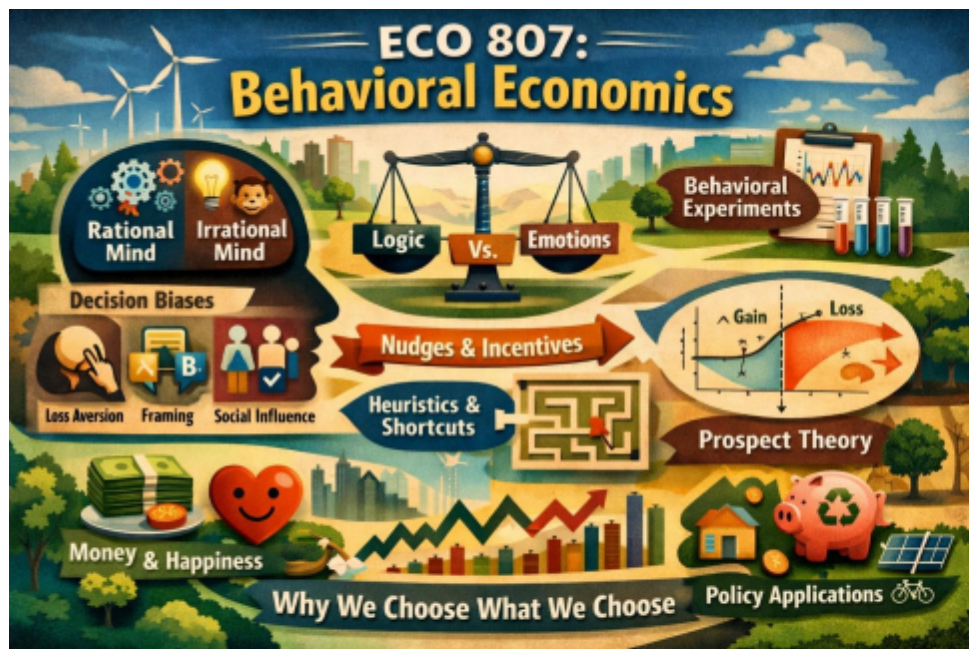
This course is designed to provide learners with a comprehensive understanding of how psychological, cognitive, and social factors influence economic decision-making. It equips learners with knowledge of heuristics, biases, risk and uncertainty, intertemporal choice, and social preferences. Emphasis is placed on applying behavioral insights to policy, finance, business, and development, enabling learners to analyze real-world decisions and promote more effective, informed, and welfare-enhancing economic outcomes.
Course Learning Outcomes
CLO 1: Explain the key concepts, theories, and terminology of behavioral economics, including heuristics, biases, risk, uncertainty, and intertemporal choice.
CLO 2: Describe how psychological, cognitive, and social factors shape individual and group economic decision-making in different contexts.
CLO 3: Apply behavioral economics principles to analyze practical issues in policy, finance, business, and development settings.
CLO 4: Evaluate decision-making processes and design informed interventions by transferring behavioral insights to new economic and real-world problems.
Course Content
Foundations of Behavioral Economics: Understanding the meaning, scope, and development of behavioral economics; examining how it departs from standard economic assumptions of full rationality, stable preferences, and perfect self control; exploring bounded rationality, bounded willpower, and bounded self interest; identifying the relevance of psychology in explaining economic behavior and decision-making;
Judgment, Heuristics, and Cognitive Biases: Examining how individuals make judgments under limited information and time; understanding heuristics such as availability, representativeness, and anchoring; exploring biases including overconfidence, framing effects, confirmation bias, and mental shortcuts; analyzing how these influence consumer, investor, and policy decisions;
Choice under Risk and Uncertainty: Understanding decision-making in risky and uncertain environments; distinguishing between expected utility theory and actual observed behavior; exploring prospect theory, reference dependence, loss aversion, and probability weighting; identifying how individuals evaluate gains and losses in economic contexts;
Intertemporal Choice and Self-Control: Examining how individuals make choices involving present and future outcomes; understanding discounting, present bias, procrastination, temptation, and self-control problems; exploring commitment devices and their role in savings, health, education, and consumption behavior;
Social Preferences and Social Interaction: Exploring how fairness, reciprocity, altruism, trust, cooperation, and social norms influence economic behavior; understanding the role of identity, peer effects, and inequality aversion in shaping group and market outcomes; analyzing behavior beyond pure self-interest;
Behavioral Game Theory and Strategic Interaction: Understanding strategic decision-making where individuals respond to the actions and beliefs of others; examining bounded rationality in games, trust games, ultimatum games, public goods games, and coordination problems; analyzing real-life strategic behavior in markets and organizations;
Experimental and Empirical Methods in Behavioral Economics: Examining the use of laboratory experiments, field experiments, surveys, and empirical methods in testing behavioral theories; understanding data collection, hypothesis design, causal inference, and interpretation of findings; evaluating the strengths and limitations of behavioral evidence;
Behavioral Public Economics and Nudge Design: Exploring how behavioral insights inform public policy; understanding nudges, defaults, incentives, framing, reminders, and choice architecture; examining applications in taxation, pensions, health, education, and public service delivery; considering welfare and ethical implications of intervention design;
Behavioral Finance and Consumer Decision-Making: Understanding how psychological factors influence financial and consumer choices; exploring limited attention, mental accounting, inertia, borrowing behavior, under-saving, and investor biases; analyzing household finance, spending patterns, and market behavior;
Applications to Development, Health, Environment, and Organizations: Examining how behavioral economics applies to development policy, health behavior, environmental sustainability, and organizational management; understanding interventions that improve welfare, productivity, compliance, and decision quality; evaluating the broader relevance of behavioral economics in solving real-world problems.