The purpose of this course is to enable you to: acquire foundational knowledge in learning sciences and human development, apply software tools for educational analysis, integrate coding techniques in educational contexts, and synthesise theoretical and practical skills for developing innovative educational solutions. By the end of this course, you should be able to: Foundations of Learning Sciences: Introduction to Learning Theories, Human Development Principles, Cognitive Processes; Educational Data Analysis Tools: Overview of Software Tools, Data Collection Techniques, Data Visualisation Methods; Coding for Education: Basic Coding Concepts, Educational App Development, Coding for Data Analysis; Integrative Educational Solutions: Case Studies in Learning Sciences, Practical Applications of Theories, Developing Educational Innovations; Human Development in Education: Stages of Human Development, Impact on Learning, Adapting Educational Strategies; Practical Application of Learning Theories: Applying Theories to Practice, Developing Learning Activities, Assessing Learning Outcomes; Software Tools in Education: Selecting Appropriate Tools, Implementation Techniques, Case Studies; Coding Techniques for Educators: Basic Programming Skills, Coding for Interactive Learning, Troubleshooting and Debugging; Innovative Educational Practices: Exploring New Methods, Technology in the Classroom Future Trends in Education; Project Development and Presentation: Final Project Planning, Execution, Peer Review and Feedback.
Course Purpose
Course Learning Outcomes
Course Content
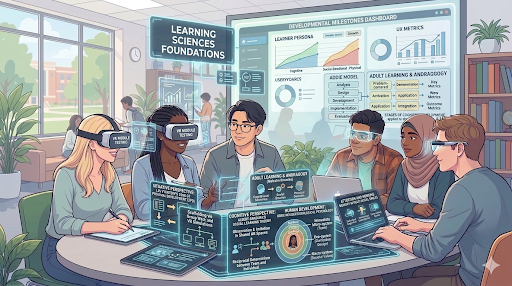
LDT 303: Learning Sciences and Human Development equips learners with a research-informed understanding of how people learn and develop across the lifespan, and with the design, technical and analytical competencies needed to translate that understanding into effective technology-enhanced learning experiences. Drawing on cognitive psychology, developmental science, instructional design, learning analytics and computational thinking, the course enables learners to move from theory to practice — analyzing learner needs, designing and building digital learning solutions, and evaluating their impact in authentic educational settings. The course covers ten modules: foundations of learning sciences and human development; principles of eLearning course design; data-driven design and learning analytics tools; coding for education, Part 1 — basic concepts and interactivity; coding for education, Part 2 — data analysis with code; software tools deep dive and case studies; integrating facilitation and assessment strategies; project Ideation and planning; project design and implementation; and project presentation, evaluation and iteration. The course is delivered fully online, combining asynchronous and synchronous modes of engagement. It emphasises interactive participation, collaborative activity and continuous learner support. Learners access diverse multimedia resources, simulations and collaborative platforms designed to enrich the learning experience. Assessment comprises continuous assessment tasks (50%) and a final examination (50%), ensuring both ongoing reflection and comprehensive evaluation of knowledge and practice.
LDT 303: Learning Sciences and Human Development Development
Course Description Course Content Course Modules
Course Purpose ...