
Ratings
Level
Learning hours

Hours
Skills you'll Learn
About this course
This short professional course equips school leaders and teachers with the knowledge, skills, and attitudes to plan, teach, and assess Mathematics using CBC-aligned, mobile-based, learner-centred approaches. You will design CBC-aligned lesson plans, create and use appropriate teaching resources, apply interactive methods such as guided discovery and collaboration, and assess learners using practical, competency-based strategies.
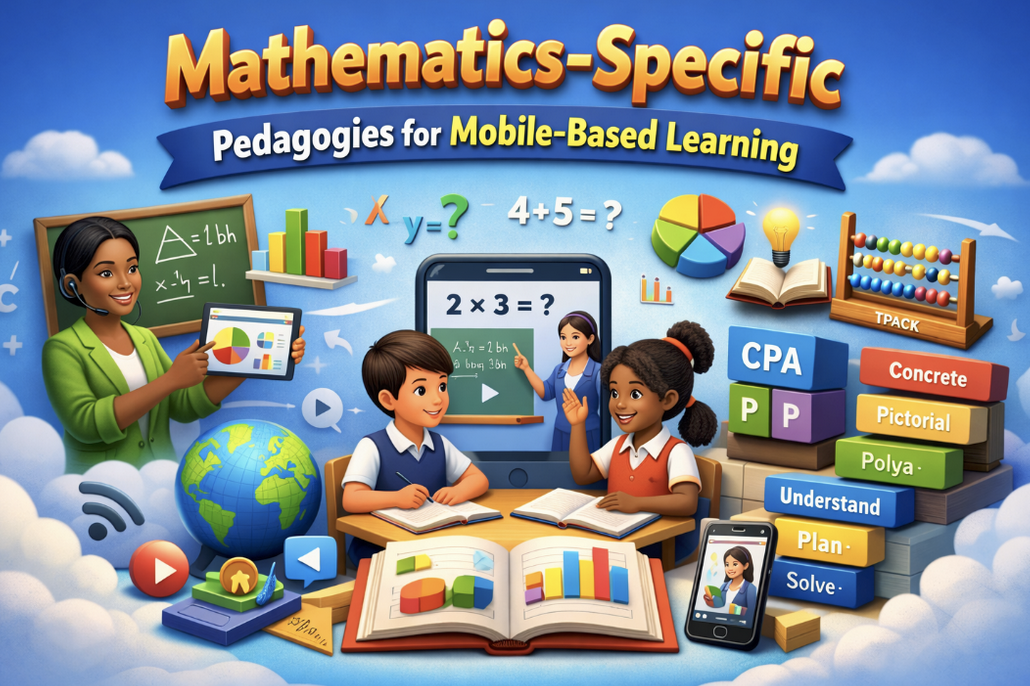
Throughout the course, you will apply key frameworks including the Concrete–Pictorial–Abstract (CPA) model, Pólya's four-step problem-solving approach, Bloom's taxonomy, and the TPACK framework. Activities are designed to be completed using a smartphone or tablet, with locally available materials — making this course accessible from your school, home, or community.
Curriculum
In this module, you will learn the pedagogical foundations for competency-based mathematics teaching, including Bruner's CPA model as a lesson-planning tool, Skemp's relational vs. instrumental understanding, and Universal Design for Learning (UDL). You will study the six-phase CBC lesson structure, practise real-life contextualisation across primary, junior secondary, and senior secondary levels, and apply inclusive and gender-responsive planning strategies. The module concludes with a CBC-aligned lesson plan as your assessed portfolio task.
In this module, you will explore how to select, create, and evaluate instructional resources guided by the CPA model, Dienes' perceptual and mathematical variability principles, and the TPACK framework. Topics include concrete manipulatives and improvisation using locally available materials, visual representations such as bar models, area models, and coordinate grids, and digital tools including GeoGebra, Khan Academy, Desmos, PhET, H5P, and WhatsApp as a teaching platform.
In this module, you will examine the full spectrum of teaching methods from teacher-centred to learner-centred, grounded in Vygotsky's Zone of Proximal Development and scaffolding strategies. You will apply Pólya's four-step problem-solving framework, Bloom-aligned questioning techniques, and wait time research. Collaborative structures covered include Think-Pair-Share, Numbered Heads Together, and Gallery Walk, along with practical strategies for managing group work in large classes. The module concludes with a teaching demonstration as your assessed portfolio task.
In this module, you will develop competency in assessing mathematics learning through assessment OF, FOR, and AS learning. Topics include diagnostic, formative, and summative assessment; designing questions at multiple Bloom's levels; rubrics for open-ended tasks; error analysis and misconception diagnosis; and Hattie & Timperley's feedback model. You will also explore growth-oriented and mobile-based feedback strategies. The module concludes with an error analysis and feedback task as your assessed portfolio deliverable.
Upon successfully completing all four modules, submitting your course portfolio — including your CBC-aligned lesson plan, teaching demonstration, and error analysis task — and passing all module mastery checks, you will receive a Certificate of Completion in Mathematics-Specific Pedagogies for Mobile-Based Learning, issued by The Open University of Kenya.