Course Purpose
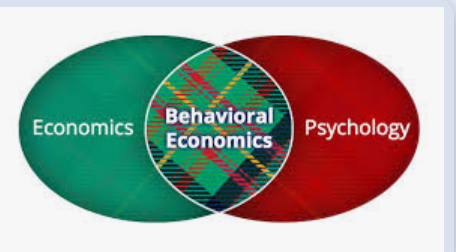
This course aims to provide a comprehensive understanding of how psychological, social, and institutional factors influence economic decision-making and outcomes. It moves beyond traditional models of perfect rationality to examine how individuals actually behave in real-world contexts, incorporating insights from behavioural economics and institutional economics.
The course focuses on how decisions are shaped by biases, heuristics, incentives, and institutional frameworks, and how these factors affect markets, organizations, and public policy. It also explores the role of institutions in structuring economic interactions and improving efficiency, accountability, and development outcomes.
Ultimately, the course equips learners with the knowledge and analytical tools to critically evaluate economic behaviour and design effective policies that enhance efficiency, equity, and sustainable development.
Course Learning Outcomes
By the end of this course, you should be able to:
ELO1: Explain key concepts in behavioural and institutional economics, including decision-making, biases, and institutions.
ELO 2: Analyze how psychological, social, and institutional factors influence individual and market behaviour.
ELO 3: Apply behavioural and institutional theories to real-world economic and policy situations.
ELO4: Evaluate and design policy interventions that improve economic efficiency, equity,Course Content
Introduction to Behavioural and Institutional Economics: Introducing the nature, scope, themes, and methods of behavioural and institutional economics; examining how behavioural economics differs from standard economic analysis; using anticipation and information avoidance as introductory examples of real-world decision-making; and exploring how behaviour and institutions shape economic outcomes.
Foundations of Decision Making: Examining rational decision making from both standard and behavioural perspectives; studying the axioms of rational preferences, generalized binary preference relations, choice functions, and revealed preferences; comparing economic and psychological approaches to human behaviour; and establishing the foundations for understanding real-world departures from perfect rationality.
Behaviour Under Risk and Uncertainty: Analyzing how individuals make choices under risk and uncertainty; examining preferences in uncertain environments; comparing standard rational models with behavioural approaches to risky choice; and explaining deviations from expected rational behaviour.
Intertemporal Choice and Self-Control: Studying decisions involving trade-offs between present and future outcomes; analyzing saving, borrowing, and consumption over time; examining present bias, self-control problems, and time inconsistency; and exploring behavioural explanations for failures in long-term planning.
Heuristics and Biases: Examining heuristics and biases in judgment and decision-making; analyzing mental shortcuts used in complex choices; identifying systematic errors arising from bounded rationality and cognitive limitations; and assessing their implications for consumer behaviour, markets, and policy.
Behavioural Game Theory: Introducing strategic decision making where outcomes depend on the choices of others; examining behavioural game theory as an extension of standard game theory; analyzing self-deception, level-k reasoning, cursedness, and other departures from perfect rationality; and applying behavioural insights to cooperation, competition, and bargaining.
Social Preferences and Collective Action: Examining distributional social preferences such as altruism and inequality aversion; analyzing intentions-based social preferences such as reciprocity and fairness; studying the free-rider problem, the logic of collective action, and the theory of groups; and assessing how collective action mechanisms reduce free-riding and support cooperation.
Institutions and Economic Performance: Defining institutions and distinguishing them from organizations; examining institutional evolution and change; analyzing how institutions shape incentives, behaviour, and economic performance; studying national and international economic institutions; and assessing the role of institutions in development, governance, and globalization.
Transaction Costs and Information Economics: Introducing transaction cost economics and the role of transaction costs in resource allocation and efficiency; examining asymmetric information and its consequences; studying moral hazard and the principal-agent problem; exploring path dependency and interlinked transactions; and assessing how transaction and information structures influence contracts, organizations, and economic performance.
Institutions, Policy and Economic Systems: Examining rent seeking, interest groups, and policy formulation; analyzing property rights regimes including private property, state property, common property resources, public goods, and club goods; studying institutional arrangements in environmental and natural resource management, including tenancy institutions; exploring economic fluctuations, money illusion, and monetary policy; examining sunspot-based fluctuations and New Keynesian price stickiness; and integrating behavioural and institutional perspectives in the analysis of policy and economic systems.